
The Monetization Flywheel
Your practical 4-phase playbook to make growth compound

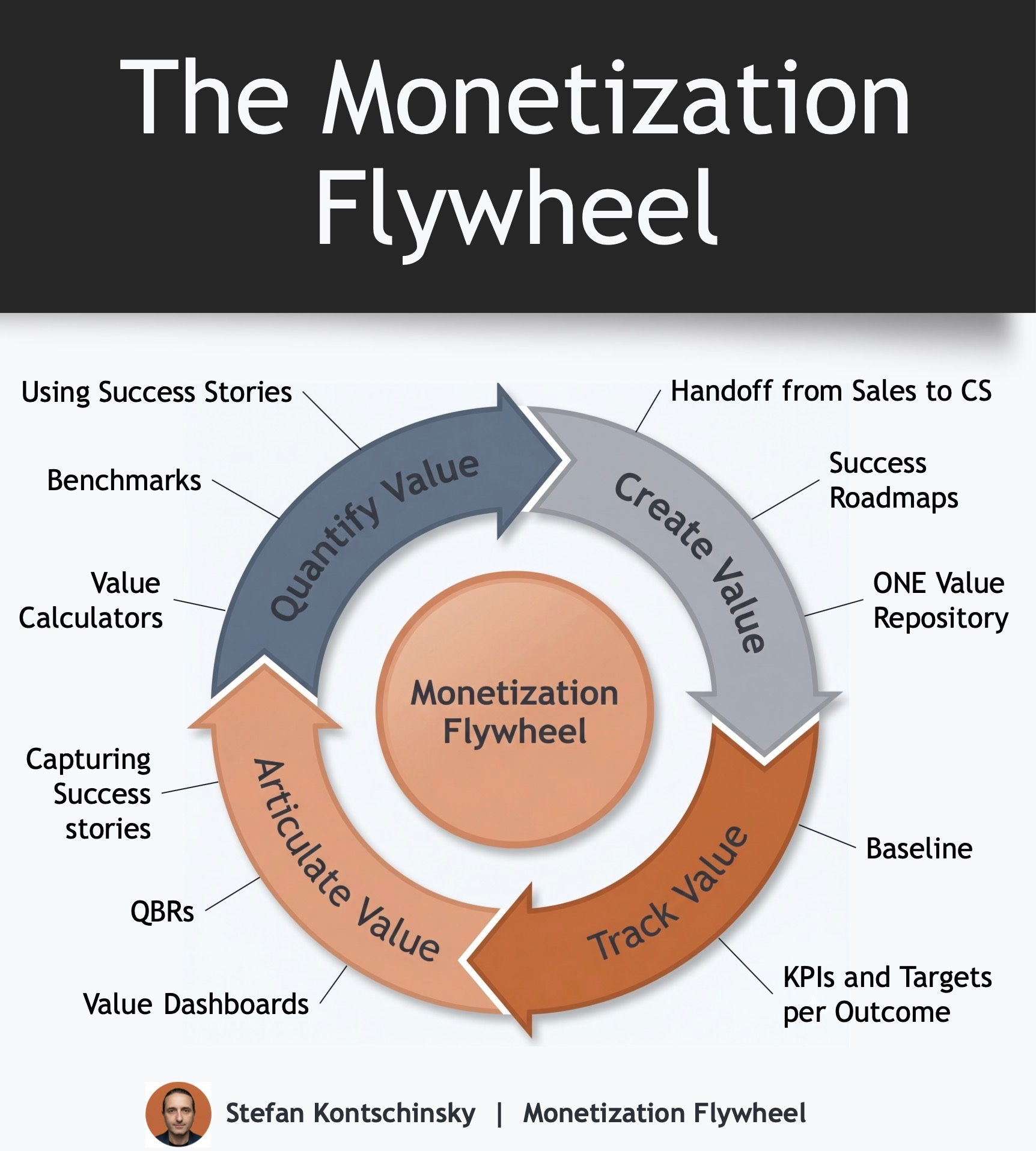
Monetization is a system. The Monetization Flywheel is the engine that enables value selling. Designed right, you can improve conversion and at the same time simplify every sale. Then value compounds, and you can focus on accelerating growth.
It has four phases: You start with quantifying value for a buyer to justify their investment. Then you create value for your customer by focusing on their success. Track value and outcomes against clear baselines, and finally articulate that value back to customers and the market.
When these phases work together, monetization becomes an engine that fuels growth where every customer outcome strengthens retention, expansion, and the next deal.
Here are that four phases, and what to focus on during each:
1. Quantify Value
To close a deal, Sales needs to convince a prospect that they get 3x-5x in potential value to justify their investment. Value often isn’t guaranteed, while spend is committed and certain. This is how B2B sales work. To convince a prospect to buy requires them to see they have a problem, and that you can solve the problem for them.
Sales Engineering / Presales quantifies the value a customer gets. To close a deal, they translate product capabilities into economic impact: Revenue lift, risk reduction, cost savings, or productivity gains. The problem is this is often done ad hoc. Value calculators standardize this across customers so reps don’t have to start from scratch for every deal. They ensure the main drivers of value are considered when negotiating deals, reducing discounting, increasing win rates and making sales more efficient.
Sales needs to convince the prospect that the value applies to them. Benchmarks and independent value studies give reps credible reference points, but prospects can question their applicability: Different industry dynamics, varying geographic needs, differences in company size. There are many reasons why they would not get the same ROI. Customer success stories from comparable customers who achieved real ROI help here. A product without success stories won’t survive very long.
That way you move from selling features and capabilities to quantifying and selling outcomes comparable customers have actually achieved.
Common pitfalls to avoid:
Forgetting about the status quo: The prospect always has the option to change nothing. Change = risk. Always address the status quo in your ROI model, and make the case for change!
Overly ambitious ‘benchmark’: Just because McKinsey or another reputable source states on average customers achieve something, doesn’t mean your customer believes this is achievable for them.
What works:
Business case based on a value calculator → standardize how value is quantified
Benchmarks & independent value stories → give reps credible reference points
Customer stories → prove that value already happened elsewhere
2. Create Value
Once a customer buys, you need to deliver on what you promised, and time-to-value becomes critical. This is where many companies struggle. A customer bought based on expected business outcomes. If the implementation and adoption is not focused on achieving business outcomes, the buyer easily ends up disappointed.
Customer Success is tasked with making sure value is realized. They build a Success roadmap with the customer, align stakeholders, and accelerate adoption to get the customer to outcomes. But they can only do that if they know what outcomes Sales has sold. In large organizations, the handoff from Sales to CS is often a failure point.
Over time things also change, commercial context gets lost. The customer might have a reorg, or just normal attrition. Your CSM might have moved to a new opportunity, Sales has long moved on to the next pitch. Chances are your signed Order Forms are in some repository, but the pitch decks? Not very likely. Then CS is left guessing what business problem the customer was trying to solve. Make sure you have ONE value repository for all docs around value, be it the value model from Sales Engineering, the pitch deck and business case from Sales, or the Success roadmap from CS.
Common pitfalls to avoid:
Treating onboarding just as a project: Timely setup and successful training are table stakes, but time-to-value means more, i.e. measurable business outcomes
Sales and CS have separate siloed repositories: Handover between teams are THE most common failure points I’ve seen over the years in many environments
What works:
Clear handoff from Sales to CS → preserve the business case and value model
Success roadmaps → tie product rollout to measurable business outcomes
ONE value repository → give Sales and CS visibility on value promised over time
3. Track Value
Aligning on outcomes is not enough. To prove value was created, you need to measure improvement against a baseline. If the first time you think about measuring impact is after the implementation is completed; or worse: during a renewal discussion, you are too late. You lost the chance to show evidence.
Customer Success needs to quantify success numerically. Outcomes need to have clear KPIs with targets so the finish line isn’t constantly moving. Stakeholders need to be aligned, especially when the buyer in the organization is not the same as the one overseeing the implementation - think of a BI tool used by Finance, but implemented and rolled out by the CIO org. The CFO signed off on the business case with certain outcomes to justify the ROI. Then the CIO organization manages your rollout. Different stakeholders, different targets.
It’s tempting to skip the baseline measurement when stakeholders ask for progress. You’re accelerating the implementation, training, and adoption to get the customer to value faster. The baseline? Gets skipped. How many staff did the team have when we sold ‘efficiency gains’? How long did the process take before we ‘accelerated revenue’? Improvements cannot be measured without a baseline though! Without it, value realization stays vague. And vague does not renew well.
Common pitfalls to avoid:
No aligned baseline: Not documenting baseline measurements of your success KPIs, or measuring but not agreeing with the customer often leads to debates later
Tracking activity instead of outcomes: Implementation progress and adoption are table stakes, but are not the same as outcomes or Return-on-Investment (ROI)
What works:
KPIs & targets per outcome → define outcomes, quantify each and set a target
Baseline measurements captured up front → set a reference point of what the KPI was before you started, so you can measure improvement later
4. Articulate Value
Once you created and measured value, articulate it back to the customer. Consistently, on an ongoing basis. If you do not communicate the impact, you are relying on the customer to connect the dots. Value not perceived might as well not exist.
Customer Success is usually responsible to protect ARR, sometimes to drive expansion. According to Gainsight’s Customer Success Index 2025, 62% of CS organizations utilize GRR as their primary metric, so they’re isolating expansion and focus purely on avoiding churn. Communicating value repeatedly, whether in QBRs or executive reviews, is the critical role CS plays to proactively address churn risk.
And for smaller customers that don’t have a CSM, value dashboards need to fulfill the same role. They need to focus on business outcomes, KPIs and progress against those. No Executive renews to increase weekly active users or other adoption metrics.
Marketing also needs to document proof points from one customer as inputs for the next prospects. Success stories with quantified outcomes, before-and-after metrics, and Executive’s quotes all strengthen the funnel and help close the next deal. That is how the Monetization Flywheel comes to spin. Value delivered to one customer becomes the proof point for the next one.
Common pitfalls to avoid:
Adoption reporting: adoption metrics are easy via telemetry, and standard across customers. Not tying them back to outcomes invites questions on why to renew
Treating customer proof points as marketing assets: Marketing usually collects “success stories”, but Sales and Presales also need them further down the funnel
What works:
QBRs and executive reviews → translate product impact into business language
Value dashboards → make progress visible for smaller customers
Capturing success stories → turn customer outcomes into future proof points
The Monetization Flywheel that works
The Monetization Flywheel only works when value is treated as a continuous commercial discipline, not a one-time sale or pricing exercise. Companies that continuously quantify, create, track, and articulate value systematically are better positioned to reduce discounting, improve renewal rates and increase expansion.
In that sense, monetization is not just about price setting and price getting, which most pricing teams focus on. Implementing the Monetization Flywheel requires a lot more cross-functional collaboration, but the effort pays off to compound growth.