
Why Outcome-based Pricing Models Break (and How Leading SaaS Teams Fix Them)
Three hidden traps that make outcome-based pricing fail, and the playbook that prevents them.

Outcome-based pricing is one of the most appealing concepts in AI pricing: charge customers only when they get results. In theory, that perfectly aligns incentives. In practice, it often fails because costs become unpredictable, attribution turns messy and “measurable outcomes” aren’t as measurable as they seemed.
Let’s unpack why this happens and how leading SaaS teams are solving it.
The Three Core Challenges of Outcome-Based Pricing
Andreessen Horowitz identified the three biggest barriers holding companies back:
The lack of clear, measurable outcomes
Unpredictable or unscalable cost
Difficulty attributing value to a specific tool or model
Each of these hides deeper operational challenges.
Challenge 1: Lack of Clear, Measurable Outcomes
This challenge stems from two root causes:
Ambiguous definitions
Different customer functions often expect different outcomes. Take marketing AI tools like Iterable for example. Marketing may focus on curated moments, while Sales wants conversion uplift. Without a shared definition of what matters, outcomes become subjective.
Loosely defined outcomes lead to debates about what is counted as “success”, even when teams agree on the intent. Unclear edge cases make billing ambiguous, create room for disputes, and those damage customer relationships.
Inaccurate or inaccessible measurement
When companies can’t provide real-time visibility in product and customers only see consumption data after manual reviews and adjustments, trust erodes quickly. Customers begin questioning the accuracy of telemetry, and invoice disputes follow.
Connecting billing measurements with in-product analytics can be complex, especially when legacy billing systems limit what can be surfaced or shared. Newer monetization infrastructure platforms like Metronome can solve this, but adopting them often requires replacing those legacy systems that many SaaS leaders rely on.
Challenge 2: Unpredictable or Unscalable Cost
When your costs fluctuate more than your revenue, outcome-based pricing becomes a financial risk.
Billing in arrears
If customers are charged only after outcomes occur, surprise bills are inevitable. The Cursor backlash in July 2024 after their price model change showed how quickly this can erode trust. AI-native startups are especially vulnerable, as we explored in “Untangling Billing and Pricing”.
Uncontrollable cost drivers
If you cannot control how many attempts it takes to achieve a successful outcome, your unit economics collapse. That’s why companies like OpenAI price APIs by tokens, not results, and why Anthropic’s Claude enforces strict usage caps.
Challenge 3: Difficulty Attributing Value
The toughest problem is attribution: which product, model, or team actually created the outcome?
Unattributable outcomes
If a supply chain platform depends on a Transportation Manager to act to avoid a stockout, who really earned that success? Charging for outcomes outside your control invites disputes.
Human-in-the-loop
Autonomous AI Agents promised end-to-end outcomes, but vendors recommend human oversight (see Scale AI). Until AI systems can act fully autonomously, and vendors are willing to assume accountability, charging for the ultimate business outcome won’t be possible.
Outcome-based pricing can quickly shift from a growth engine to a liability if these traps aren’t managed. Let’s look at how to design it right.
The Playbook: Get Outcome-Based Pricing Right
Step 1: Identify the Direct Outcome Your Product Creates
Price the outcome your product actually delivers, not the business value a customer can ultimately create with your product. Attribution becomes questionable when your product doesn’t make decisions or someone else needs to act to achieve the outcome. Attribution clarity builds pricing credibility.
Step 2: Pick the Right Pricing Architecture
Not all outcomes are binary. Match your model to your outcome type:
Fixed price per outcome → for binary events (e.g. “identify verified”)
% of achieved outcome → for performance-based gains (e.g. revenue uplift)
Refunds or guarantees → to share risk (e.g. Fin AI’s $1M dollar guarantee)
Hybrid models → combine fixed and variable components
(For more, see “100+ Companies Charge for Outcomes Across 15 Industries. Why Aren’t You?”)
Step 3: Define Outcomes Clearly and Document Exceptions
Ask “What if...?” early. How are outcomes counted? What if the outcomes change after being achieved? Document all these in your pricing terms or FAQ.
Fin AI, for instance, specifies exactly what a “resolved conversation” means, including edge cases like a chat ending right after a greeting, or a customer revisiting a resolved case weeks later.
Define outcomes precisely. Ambiguity is your enemy.
Step 4: Consider a Platform Fee or Contract Minimum
Outcome-only pricing can make small accounts unprofitable. Consider adding a platform access fee to cover fixed costs or a minimum contract value to reduce CAC pressure.
This ensures you don’t lose money on customers with volatile results.
Step 5: Layer on Flexibility for an Upcharge
Encourage customers to forecast and commit to a baseline number of outcomes to get subscription-like predictability (See “Untangling Billing and Pricing” for more.)
Offer flexible commitment options, but price that optionality. It’s not uncommon to charge 33%-50% more for pay-as-you-go billing in arrears. For example,
DataDog charges 50% more for on-demand events ($3) vs billed annually ($2)
ZenDesk’s AI is 33% more expensive with pay-as-you-go ($2) vs committed ($1.50)
Step 6: Offer Customers a Choice
If your customers aren’t ready for full outcome-based pricing, offer an alternative as Decagon does, letting customers choose between outcome- and usage-based models.
Customers value choice. Offering the choice of outcome-based pricing signals confidence in our ability to achieve the outcome, and your willingness to share the risk with your customer.
Decision Tree: When Not to Price by Outcomes
Outcome-based pricing only works when you can control cost and predict how it scales. If you can’t, it quickly becomes a liability.
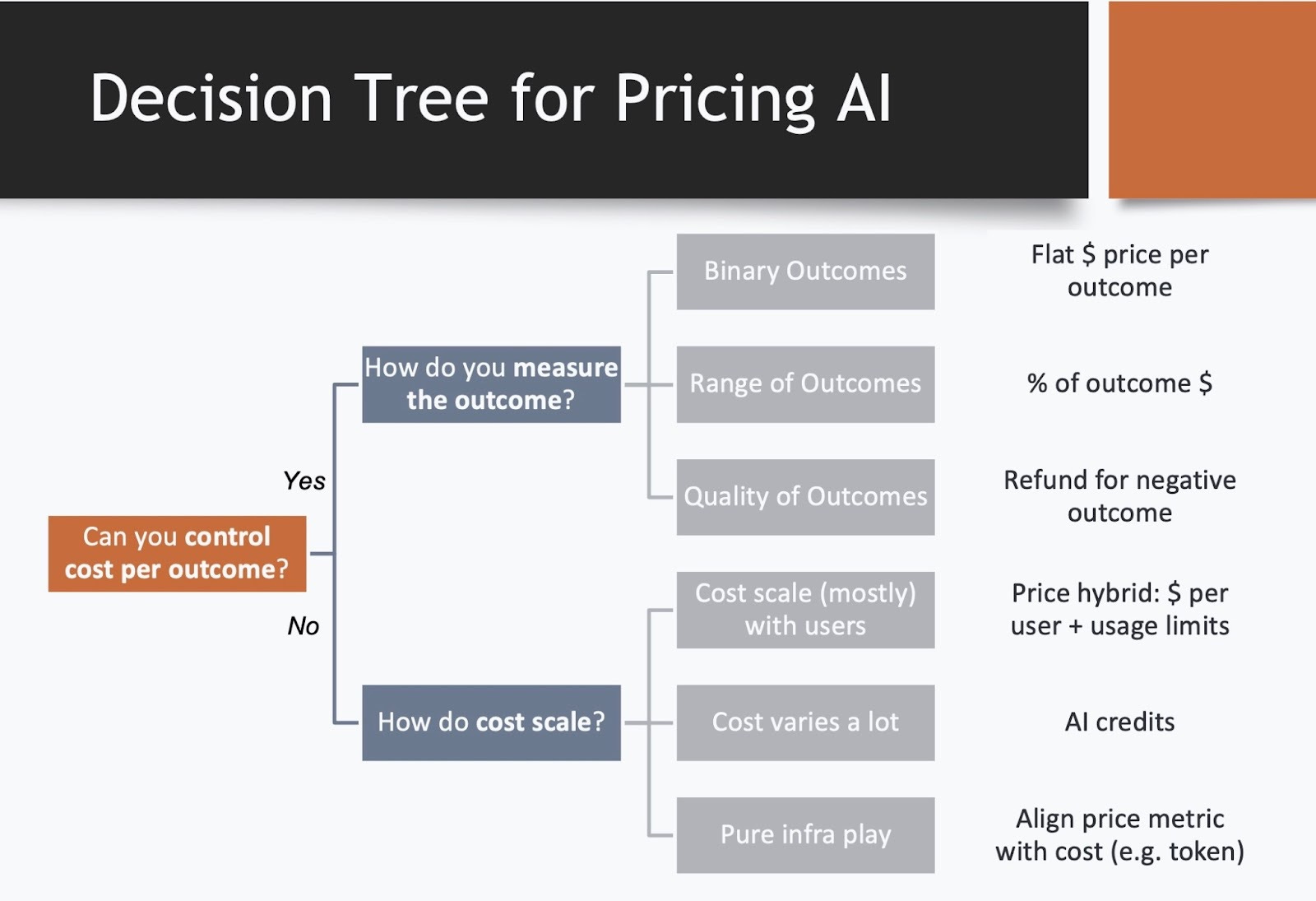
Most cost spirals come from variability: fluctuating success rates, unpredictable AI token use, long-running calls in voice AI, etc etc.
When that happens, price on what you can control:
Cost scale with users → use per-user pricing with usage limits
Cost varies by task → use AI credits to tie price to compute (e.g. Adobe charges more credits for high res video generation)
Pure infrastructure → align price directly to usage (e.g. OpenAI API). But…
Beware The Downward Spiral of AI Cost Decline! Stanford’s 2025 AI Index Report found hardware costs declined ~30% annually, and energy efficiency improved by ~40% each year. If your pricing is tied directly to these costs, your margins will erode as customers expect your prices follow suit. That’s why pricing must link to customer value, not raw compute cost.
Closing Thought
Outcome-based pricing works when you own the outcome, measure it precisely and control the cost to achieve it. When you can’t, a hybrid structure with usage-limits, or usage-based pricing keeps your business stable while you mature your telemetry and attribution.
Companies that win with outcome-based pricing design for measurability up front.